Untreated vs. Treated or Synthetic Corundum: A Deep Gemological Analysis
In the world of fine gems, few distinctions are more consequential than that between untreated natural corundum and its treated or synthetic counterparts. While all three may look superficially similar, their origins, structural integrity, and market value vary significantly. Understanding these differences isn’t just academic—it’s essential for appraisers, gemologists, and collectors alike.
This article offers a deeper technical dive into how experts distinguish untreated corundum (both rubies and sapphires) from treated or synthetic specimens using advanced gemological tools and market context.
The Nature of Corundum: A Quick Recap
Corundum is crystalline aluminum oxide (Al₂O₃), typically forming in metamorphic or igneous environments. The presence of trace elements such as:
- Chromium → red (ruby)
- Iron and titanium → blue (sapphire)
- Vanadium, magnesium → purples, yellows, greens
These color-producing impurities can also help determine geological origin and treatment history.
TREATMENTS: A CRITICAL DISTINCTION
- Heat Treatment
- Purpose: Improves color, removes rutile silk (which can obscure clarity), dissolves inclusions.
- Detection:
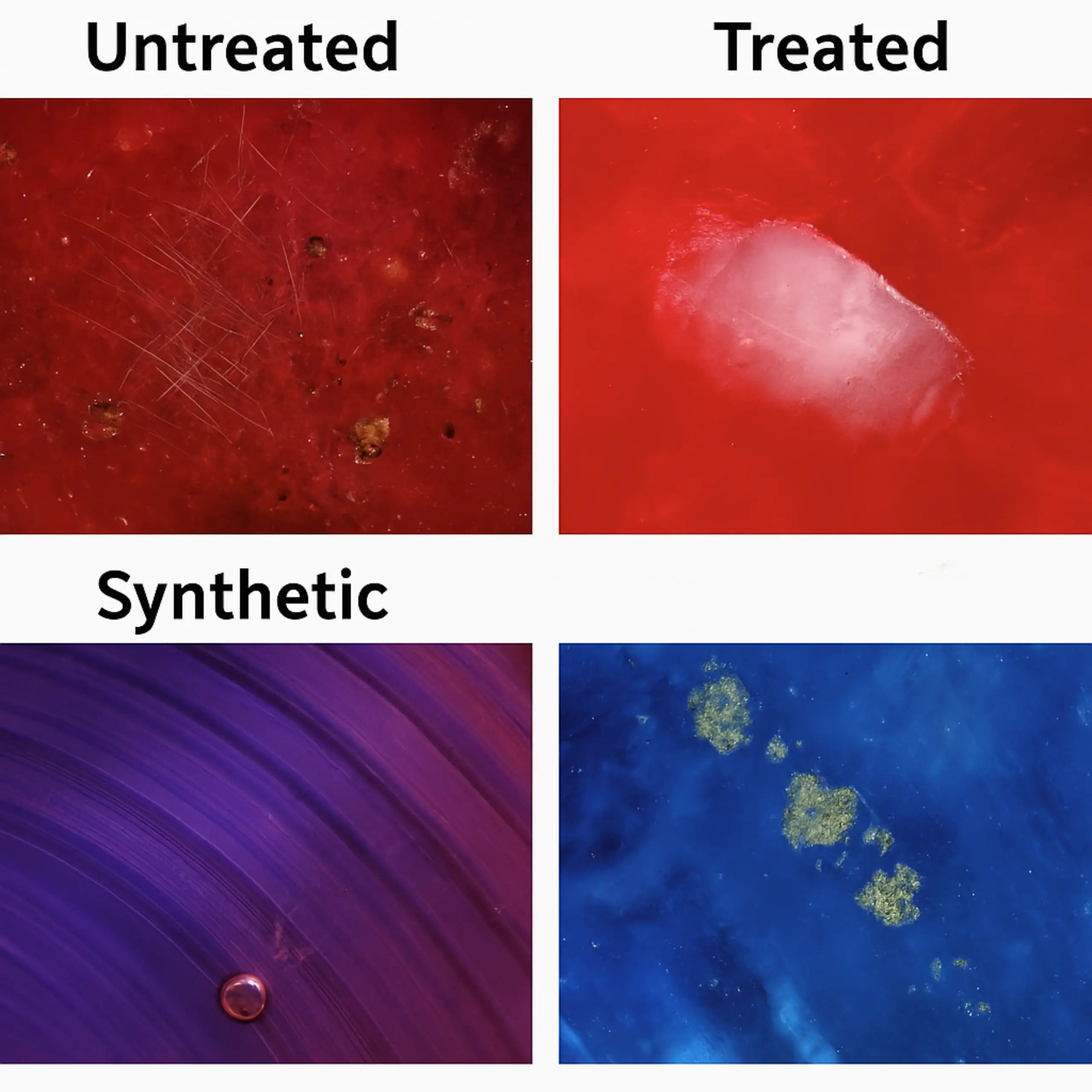
- Melted rutile silk: Under microscopy, silk appears "smeared" or forms discoid stress halos.
- “Snowball” inclusions: Often indicate high-temperature exposure (>1800°C).
- FTIR spectra: Can show features like absorption peaks near 3160 cm⁻¹, linked to hydroxyl groups affected by heating.
- Diffusion Treatment
- Surface Diffusion: Adds color via diffusion of chromophores (e.g., titanium for blue, beryllium for yellow-orange).
- Detection:
- Color-concentrated outer rim under immersion or cross-section.
- Polariscope or darkfield illumination can show unnatural zoning.
- Fracture Filling (e.g., lead-glass in rubies)
- Purpose: Improves transparency of heavily fractured corundum.
- Detection:
- Gas bubbles trapped in filler
- Blue or orange flashes at fracture boundaries
- Low durability: Filler can degrade in cleaning solvents or heat.
SYNTHETIC CORUNDUM: IDENTICAL YET ARTIFICIAL
Synthetic corundum shares the same physical, optical, and chemical properties as natural corundum, making detection more complex.
- Flame Fusion (Verneuil Process)
- Common in inexpensive synthetics
- Telltale signs:
- Curved growth striae (not found in natural corundum)
- Gas bubbles (often spherical and isolated)
- Unnatural fluorescence under shortwave UV
- Flux Growth
- Used in high-quality synthetics (e.g., Chatham)
- Detection:
- Flux inclusions: Droplet-shaped with a metallic appearance (from molybdenum or borate fluxes)
- Growth patterns: Can mimic natural zoning, but with irregularities
- Hydrothermal Growth
- More realistic inclusion patterns
- Detection:
- Microscopic etch channels
- Often requires Raman spectroscopy or EDXRF to confirm trace elements inconsistent with natural origin.
DETECTION METHODS: BEYOND THE LOUPE
While basic field tools (loupe, microscope, UV light) are valuable, high-level analysis often requires advanced techniques:
- Raman Spectroscopy
- Determines mineral identity and detects flux residues
- Non-destructive, high-resolution
- FTIR (Fourier-transform Infrared)
- Identifies heat treatment, polymers, glass
- Excellent for lead-glass fillers
- EDXRF (X-ray fluorescence)
- Trace element profiling
- Helpful in origin and diffusion detection
- UV-Vis-NIR Spectroscopy
- Evaluates chromophore patterns
- Great for distinguishing synthetic vs. natural coloration
MARKET IMPLICATIONS
- Untreated natural corundum
- Untreated natural corundum is considered stable.
- Market value is high
- The likelihood that you will come across one is rare (<1% for rubies)
- Heat-treated corundum
- Heat treated corundum is considered stable
- Market value is moderate
- Very common in the marketplace (90%+ of sapphires)
- Diffused/Fracture-filled corundum
- Considered less stable
- Market value is low
- Common in low-end market
- Synthetic Corundum
- Synthetic corundum is stable
- Market value is normally very low (unless disclosed)
- Synthetic corundum is mass-produced
Two notes to make and treatment status:
- Insurance values and investment-grade appraisals are heavily impacted by treatment status.
- Origin (e.g., Kashmir, Burma, Ceylon) plus untreated status can exponentially raise value.
WHY IT MATTERS
For collectors, retailers, and investors, distinguishing between untreated, treated, and synthetic corundum is not just a technical detail—it’s a matter of integrity, price, and long-term value. The challenge lies in increasing sophistication of treatments and synthetics, which can mimic nature with startling accuracy.
In a market where two stones can appear identical but differ in price by a factor of ten or more, gemological literacy is not optional—it’s essential.
There’s beauty in all corundum, whether natural or synthetic, but knowing what you’re looking at (and paying for) is critical. As the industry advances, so too must our ability to analyze, detect, and disclose. For those seeking assurance, working with a gemologist and demanding full disclosure (preferably with lab certification) is the safest route.